The border
You choose the declaration, the border decides the rest
Every parcel leaves with a declaration attached. The operator's customs article says you can choose between a personalised declaration and the system declaration when you submit the parcel, and points to its tariff threshold reference for what different destinations tend to allow (%s).
What it does not do, and cannot do, is promise an outcome. The same article states that whether tariffs are imposed depends on inspection frequency and local policy, and that the recipient is responsible for customs related risks including returned packages, fines and taxes.
What raises the odds of a check
The operator names three things directly: a heavy parcel, a large quantity of similar products, and high value goods, adding that heavy or valuable parcels increase the chance of random inspection. It advises avoiding parcels that are excessively heavy or that contain many copies of the same item.
That advice sits awkwardly next to the arithmetic of combining, and it is the honest tension in this whole guide. Combining saves money by making one bigger parcel. Past a certain size, a bigger parcel is exactly what a customs service treats as commercial. The point where those two lines cross is different for every destination, which is why nobody can hand you a number and call it advice.
What is yours, what is theirs
The split of responsibility is written down, and it is worth reading before a problem rather than during one.
A parcel returned by domestic security
The operator states that if a parcel is returned inside China for security reasons, it will contact you and resend it free of charge (checked 4 August 2026).
A parcel returned from abroad
Where a parcel comes back because of an address problem, a failed delivery or an international security rule, the redelivery cost falls to the recipient.
Duty, tax and fines
Customs charges are the recipient's. If customs asks for an invoice or clearance proof and it is not provided, any resulting fees are the recipient's too.
Goods judged to be imitations
The operator says it verifies material and category but cannot determine whether goods are genuine, and that confiscation of items judged imitation or sensitive falls to the recipient.
Practical rules that do not depend on your country
Specific thresholds are local and they move, so this table deliberately contains none. What it contains is the behaviour that holds everywhere.
| Situation | What to do | Why |
|---|---|---|
| You are close to the weight where a parcel looks commercial | Split the haul into two parcels | The operator names weight and piece count as the signals customs uses, and 10 kg as where commercial treatment becomes more likely |
| You bought several of the same item | Spread them across parcels or across time | Quantity of one item is the other signal named |
| The item is liquid, powered or aerosol | Check the route before combining | Route restrictions apply to the whole parcel, not just to that item |
| You are asked for an invoice on arrival | Send it quickly and keep a copy | Failure to provide clearance information can turn into a return, and the costs of that fall to the recipient |
| The declared value looks low next to the contents | Think about it before you submit | A declaration is a statement to your own customs service, and you are the one it belongs to |
Signals and responsibilities quoted from the OrientDig customs risk article and its sign off notices (checked 4 August 2026). Duty thresholds are set by your country and are not reproduced here.
When the parcel arrives
The last stretch has its own rules and they are short. Check for obvious damage while the courier is still there. If the box is visibly damaged, either note it or refuse the parcel. If you sign without checking and then find a problem, keep the original packaging and send photos and the invoice within two working days so the operator can take it up with the local post. Anything else goes to customer service within 72 hours (checked 4 August 2026).
The operator also states that a normal signature ends the shipping process and that it will not take responsibility after that point, and that claims on fragile goods are for loss rather than breakage. Those two lines are why the packing decisions matter more than the insurance decision.
The exchange rate is a cost, and it is charged twice
Listings are priced in yuan. The figure you see in dollars or euros is a currency conversion done at the moment the page loaded, and the operator says as much next to it. The rate you actually pay is settled when money moves, not when the page was drawn, so the two numbers rarely match exactly.
It is charged twice because there are two payments. Converting CNY to USD or EUR happens once when you fund the goods and once when the international leg is billed, and a card or wallet may add its own spread on top of the operator's. None of that is hidden, but none of it is shown as a single line either.
For a declaration this matters directly: the value written on the customs form is a converted figure too, and it is the converted figure a border service reads.

Other shopping agents, and why the routes look familiar
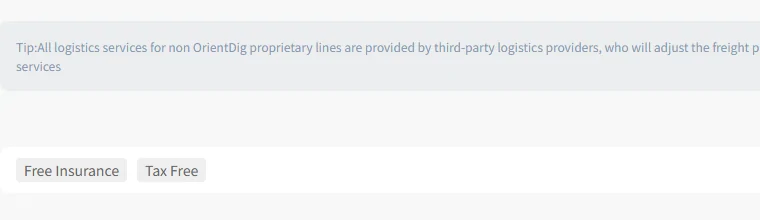
There are dozens of other shopping agents serving the same buyers, and at the logistics end most of them are reselling the same handful of lines. The operator says so itself: services on routes it does not own are provided by third-party logistics providers who set the freight price according to market conditions. That is why two agents can quote the same carrier and still differ on everything around it.
So the differences that are real sit beside the route rather than in it: what the service fee is and whether it is waived, how the currency conversion is applied, how long free storage runs, how many inspection photos are included, and what the written procedure is when a parcel is lost. Comparing agents on headline shipping prices alone compares the part they share.
This guide is written about one agent and does not rank the others. If the terms above matter more to you elsewhere, that is a reasonable reason to buy elsewhere, and nothing here is improved by pretending otherwise.