
Packing
The packing choices are made once, on one screen
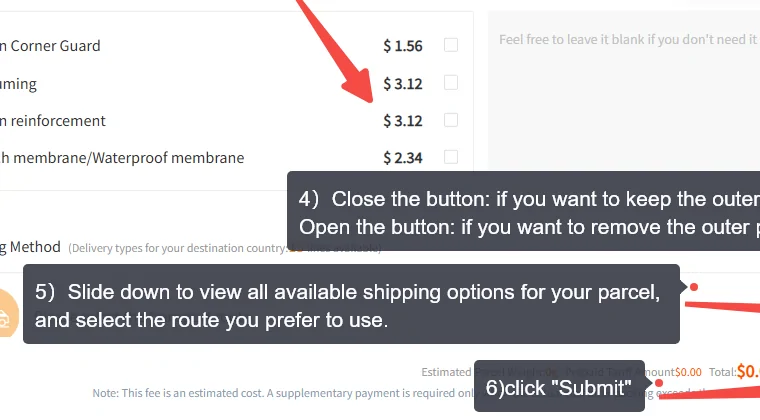
When you submit a parcel, the same screen that asks which items travel together also asks how they should be packed. There is a switch for removing outer packaging, a list of value added services with a price against each, and a note that additional services such as removal of packaging, reinforcement of the package and insurance can be requested (checked 4 August 2026).
Every one of these choices changes either the weight, the volume or the risk. None of them can be revisited after the box is taped, which is why they are worth two minutes rather than a reflex tick.

Protection and weight pull in opposite directions
There is no setting that is right for every box. Stripping packaging makes the parcel lighter and smaller and less protected. Adding reinforcement does the reverse, and costs a fee per parcel on top. The right answer depends on what is inside and on how much the original boxes are worth to you.
One asymmetry is worth knowing before you decide. The operator states that claims on fragile and vulnerable goods are accepted for loss rather than damage, regardless of whether strengthening packaging was used (checked 4 August 2026). Reinforcement is therefore a way to reduce the chance of breakage, not a way to make breakage claimable.
What is on the add-on list
The list on the submit screen is short and priced item by item. In the official tutorial capture it includes pearl cotton wrapping, a folding shoe box option, a shoe tree, corner guards, vacuum compression, carton reinforcement and a stretch or waterproof membrane, each with its own amount next to it.
We are deliberately not reprinting those amounts as current prices. They were the values on the operator's own screen when the tutorial was captured, and value added service pricing is exactly the sort of thing that moves quietly. The list is what matters: it tells you the vocabulary to look for in your account.

Four choices, and what each one is really for
Read these as trade-offs rather than upsells. Two of them save money, two of them spend it, and which pair applies depends entirely on what is in the box.
Remove outer packaging
The single biggest volume saving available on a clothing or shoe haul. It is also irreversible, and it takes the tags and boxes with it, which matters if you intended to resell.
Compression on soft goods
Hoodies, down jackets and padded outerwear are mostly air. Compressing them can move a parcel down a weight band on volume.
Reinforcement and corner guards
Sensible on anything rigid or breakable, and on heavy boxes that will be handled several times. Remember it adds weight and a fee, and it does not make breakage claimable.
Stripping packaging on collectible items
If the box is part of the value, removing it converts a collectible into a used item. That is a shopping decision disguised as a shipping one.
What each choice does to the three things that matter
Weight and volume decide the freight. Risk decides whether you are dealing with a claim afterwards.
| Choice | Weight | Volume | Risk | Cost |
|---|---|---|---|---|
| Keep all original packaging | Up | Up a lot | Lower | None |
| Remove outer packaging | Down | Down a lot | Higher for rigid goods | None |
| Fold shoe boxes flat | Same | Down | Slightly higher | Per parcel fee |
| Compress soft goods | Same | Down | Neutral | Per parcel fee |
| Add reinforcement | Up | Slightly up | Lower for breakables | Per parcel fee |
| Add waterproof wrap | Slightly up | Same | Lower in wet handling | Per parcel fee |
Option names taken from the OrientDig submit parcel screen in the official tutorial (checked 4 August 2026). The directions in this table are our own reading of what each option does, not operator claims.
Insurance, and what it is for
Insurance is requested at the same point, in the remarks on the submit screen. The exemption clauses in the operator's sign off notices are the part worth reading first, because they define what any cover can be about: claims on fragile goods are for loss rather than damage, dangerous and prohibited goods are excluded, and losses from weather, customs delay or the natural properties of the goods are not covered (checked 4 August 2026).
In practice that means insurance answers the question what if the parcel never arrives, not the question what if my sneakers arrive creased. For creases and dents, packing choices are the lever, not cover.